

 For patients across Upstate New York, living with Essential Tremor and Parkinson’s Disease, a treatment once confined to a handful of academic centers in large urban areas is within reach at United Health Services (UHS) in Binghamton, NY: magnetic resonance–guided focused ultrasound (MRgFUS). This technology delivers hundreds of ultrasound beams through the skull, guided by MRI, to a millimeter-scale target deep in the brain, generating enough heat to create a precise therapeutic lesion—without an incision, a burr hole, anesthesia, or ionizing radiation. UHS was the first healthcare system in Upstate New York to offer MRgFUS. Since launching the program in December 2024, UHS has treated more than 180 patients. More than 30,000 MRgFUS procedures have been performed worldwide.

MRgFUS, commonly referred to as Focused Ultrasound, is FDA-approved for the treatment of Essential Tremor and Tremor-Dominant Parkinson’s Disease. The initial FDA approval in 2016 covered unilateral thalamotomy of the ventral intermediate nucleus for the dominant hand. Because most patients with Essential Tremor have bilateral symptoms, a multicenter trial of staged bilateral thalamotomy was subsequently completed, and its results supported FDA approval of staged bilateral ablation for Essential Tremor in 2022 (Kaplitt et al., JAMA Neurology, 2024). FDA approvals for Tremor-Dominant Parkinson’s Disease subsequently occurred in 2018 (unilateral tremor), 2021 (unilateral motor complications), and 2025 (staged bilateral motor complications).
An incisionless alternative to open surgery, Focused Ultrasound is performed inside an MRI scanner, which provides real-time target definition, treatment planning, and closed-loop thermometry so the Neurosurgeon can monitor tissue temperature and lesion location as energy is delivered in an awake patient. That “triple feedback” of immediate clinical response, live thermography, and anatomical imaging allows low-temperature test sonications to confirm clinical benefit and identify potential adverse effects before creating a permanent lesion, offering an advantage over the delayed and less predictable effects of radiosurgery (Krishna et al., JAMA Neurology, 2018). Unlike deep brain stimulation, Focused Ultrasound does not require cranial surgery, implanted hardware or ongoing device management. The procedure is performed on an outpatient basis and patients typically experience improvement immediately following treatment.
Focused Ultrasound is generally well tolerated by patients. The most common early adverse effects are gait disturbance and paresthesias, which tend to subside over time; other reported effects include dysarthria, ataxia, taste disturbance, and speech difficulty (Hamani et al., Journal of Neurosurgery, 2026). In the real-world staged bilateral cohort, approximately 45% of patients reported at least one adverse event within six months—most commonly sensory disturbance (27%), instability (12%), and dysarthria (12%)—with nearly all events characterized as mild (Vilas et al., Movement Disorders, 2026). Clinicians should counsel patients that bilateral treatment carries a somewhat higher adverse-event rate than unilateral ablation, historically driven by speech and balance effects, which is why bilateral procedures are staged (Kaplitt et al., JAMA Neurology, 2024).
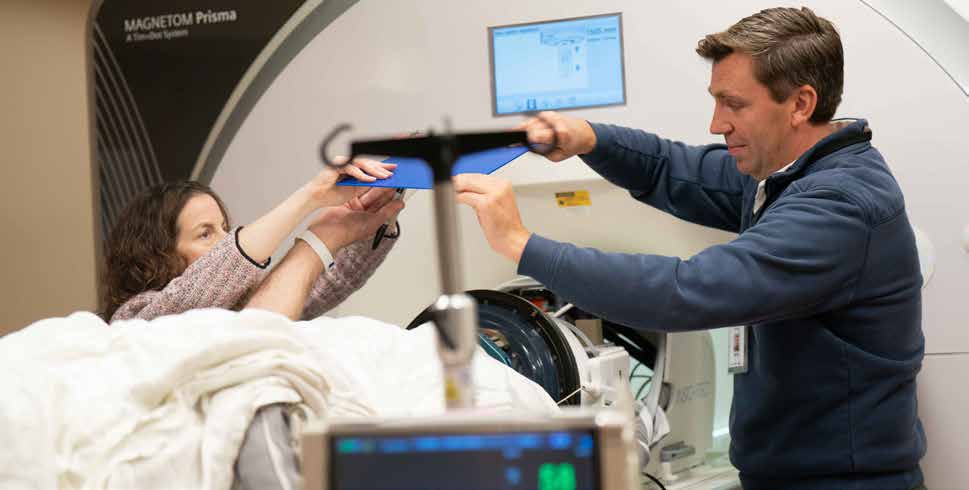
Clinical studies continue to demonstrate durable outcomes. Five-year follow-up data following first side treatment showed a 73.1% improvement in tremor severity, a 44.5% improvement in functional disability and quality-of-life measures and no serious or delayed adverse events.
FDA clinical trial data for second-side treatment demonstrated an 80.2% improvement in tremor severity at six months, as well as improvements of 64.3% in tremor and motor function and 74.3% in functional disability, reflecting meaningful gains in patients’ ability to perform daily activities independently.
“Because we were the first program in Upstate New York to offer this technology, we have developed significant experience in treating patients with Focused Ultrasound,” said Simone Betchen, MD, MBA, Chief of Neurosciences/Attending Neurosurgeon. “That experience allows us to refine patient selection, enhance outcomes and deliver an exceptional patient experience with care close to home.”
During evaluation, patients undergo imaging studies, including an MRI and CT scan, to assess skull characteristics necessary for treatment. Certain implanted devices and medical conditions may affect eligibility, although ferromagnetic implants, including some pacemakers, do not automatically exclude patients from consideration. With no upper age limit for treatment, Focused Ultrasound expands treatment access for patients who may not be candidates for more invasive procedures. The treatment is covered by Medicare, Medicaid and most commercial health insurance plans.
Essential Tremor affects approximately 2% of the population and is ne arly 10 times more prevalent than Parkinson’s Disease. The condition can significantly impact an individual’s quality of life, interfering with activities of daily living, employment, communication and hobbies. Although medications can be effective initially, many patients experience diminishing benefit over time or develop intolerable side effects. Similar challenges occur in patients with Tremor-Dominant Parkinson’s disease, creating a need for alternative therapies.
Potential candidates generally should:
Be at least 22 years old for treatment of Essential Tremor or at least 30 years old for treatment of Tremor-Dominant Parkinson’s Disease
Have disabling tremor or tremor impacting activities of daily living, despite medical management
Be able to tolerate MRI imaging without significant claustrophobia
Be able to remain still for approximately one to two hours
Be able to communicate throughout the procedure
Meet MRI safety requirements
“The Focused Ultrasound procedur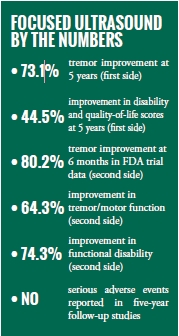 e is performed at the UHS Salanger Outpatient Center located in Vestal, while initial evaluations and follow-up visits may occur in-person at UHS Neurosurgery in Johnson City or via telehealth,” said Betchen.” “Patients may be referred by a neurologist or primary care physician, or they may self-refer through our website.
“As Focused Ultrasound technology becomes more widely available across Upstate New York, primary care physicians, neurologists, and movementdisorder specialists have an evidencedbased, safe and incisionless treatment option for patients whose symptoms remain inadequately controlled with medication and who may not be candidates for invasive surgery,” said Kate Foxx, MD, Attending Neurosurgeon.
 UHS is the Southern Tier’slargest and most comprehensive healthcare system. UHS Neurosurgery offers the region’s most comprehensive brain and spine care program, built on more than 40 years of leadership in the field and offers comprehensive adult neurosurgical care, including cranial and spine surgery for cerebrovascular disease including open vascular and endovascular treatment of aneurysms, brain and spine tumors, degenerative spine disease, spine deformities, and neuromodulation. UHS is also Joint Commission certified as a Comprehensive Stroke Center and Core Spine Surgery program.
For more information, call 607.763.5404 or visit nyuhs.org/focused-ultrasound. Referrals may be faxed to 607.203.4245.