
Traditional healthcare hierarchies placed physicians at the top with various nurses in supporting roles–nurse practitioners, registered nurses, licensed practical nurses, and medical assistants, in that order. But in today’s complex and increasingly specialized medical environment, a cooperative team approach becomes necessary. Quality physicians look to their nursing staff to work with them to promote better outcomes for patients.
That is clearly the case at Syracuse Community Health (SCH), where Ofrona Reid, MD, MBA, MS, president and chief executive officer, not only recognizes the value of the nursing staff but also supports them furthering their education. He wants them to jump from LPN to RN, if they choose, and has structured the work environment to achieve this.
“Dr. Reid has fostered a culture that encourages professional growth, and as a result has been able to build the next generation of healthcare professionals and has strengthened healthcare right here in Central New York,” said Jessica Yoxall, vice president and chief operating officer at SCH.
In fact, he is so cognizant of the importance of the facility’s nurses that he chose not to be interviewed for this article; instead, he wants the nurses to tell their own stories. This article is the result of those interviews.
Fifty Years of Serving the Underserved
 Syracuse Community Health was founded in 1978 with the mission to provide high-quality healthcare to the residents of Onondaga County, especially those who are uninsured, disadvantaged or who face other obstacles to care.
Nearly 50 years later, the health center has cared for more than 100,000 residents of Onondaga County, 91 percent of whom live in the city of Syracuse. In addition, 78 percent of patients are covered by Medicaid, Medicaid Managed Care or are uninsured; 92 percent have an annual income below 200 percent of the poverty line, and 45 percent are under the age of 21.
SCH opened a new, 56,000 squarefoot facility in 2023 at 819 S. Salina St., Syracuse. Patients can access care at 12 other clinical locations, eight of which are located inside Syracuse City Schools, convenient for parents who are unable to either take time off work or transport their child to a medical appointment. In addition to the main site, the nonschool- based sites are 930 S. Salina St., 1938 E. Fayette St., 603 Oswego St., and on the Onondaga Community College campus.
“Our clinics are intentionally and strategically located along transportation routes and in zip codes that contain demographic challenges,” Yoxall said.
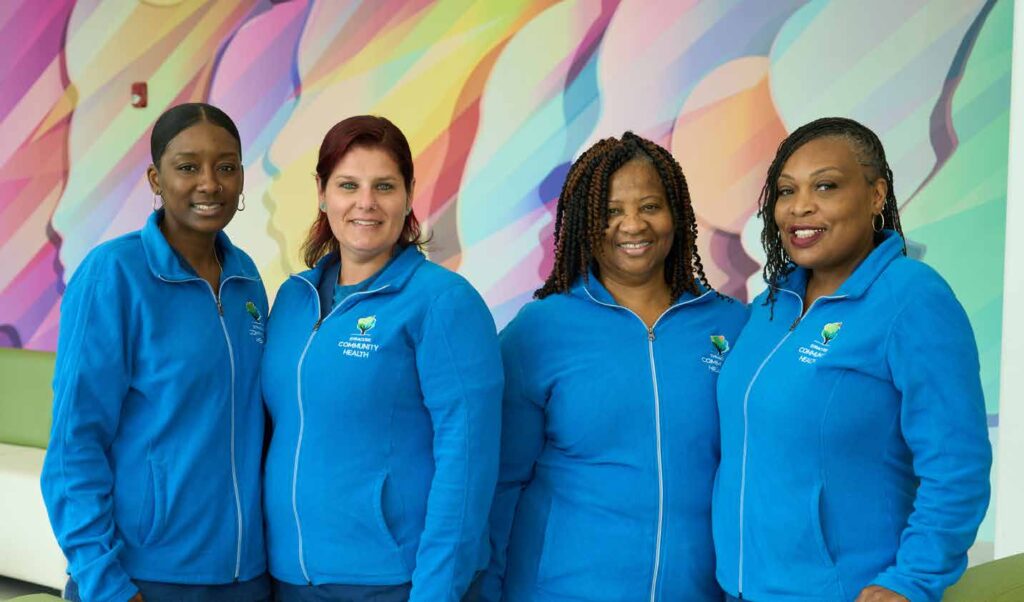
 SCH employs 200 staff, 23 of them nurses, including eight Registered Nurses and 15 Licensed Practical Nurses. “Nurses are the center of our organization and create the first impression for our patients,” said Yoxall. “We may not be able to pay the highest amount, it’s not the easiest job, not the highest paying, but it is the most rewarding. Our nurses are working here because they want to be here.”
At SCH, nursing duties often extend beyond traditional clinical responsibilities- helping patients navigate their social needs such as food insecurities and housing. “You’ll see them helping out at check-in meeting the patients where they may need help, providing compassion, dignity and respect,” said Yoxall. “Our nurses’ dedication embodies SCH’s mission.”
Working as a nurse isn’t easy but it is incredibly rewarding, satisfying and motivating. Sherri Henderson-Mitchell began her career at SCH in 1991 as a volunteer in the pharmacy, a role she said, “ignited my passion for healthcare.” She began working at SCH in October 2000 as a certified dental assistant and earned her LPN in 2009; she is currently attaining her RN.
She cites as motivation the support SCH has given her as well as SCH’s patient population. “My commitment to my patients and my community remains a primary source of motivation for my continual professional development,” she said. “Over the years, the evolving demographics of our patient population have presented new challenges that, in turn, have created opportunities for personal and professional growth.”
Sarah Platt, RN, came to SCH as an LPN and currently works as RN supervisor in the Pediatrics Department. “What brought me to SCH was the opportunity to service the children in my community,” she said. “My motivation to stay with SCH while continuing to advance my career was knowing I was going to be able to continue doing something that I enjoy. Watching the children com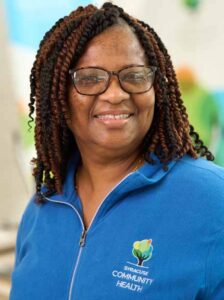 e in as newborns and reach each milestone as they grow up brings the workday extra brightness.”
Maizie Millwood’s first contact with SCH was as a patient and her first job there was as secretary even though she already was a Certified Medical Assistant. She is now an RN. Three factors fuel her desire to remain at SCH. “I am motivated by the organization’s mission, the supportive work environment, and the chance to continue learning, growing and contributing to a team that is committed to improving the health and well-being of our patients,” she said.
Bre Anna Odom came to SCH as an intern in the Medical Assistant pr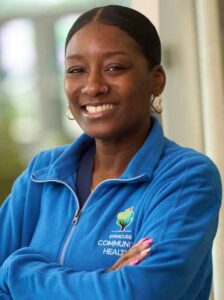 ogram before she was hired in the same role in the Eye Care Department. She then worked as an LPN for approximately 10 years when she decided it was time to become an RN. Her motivation to stay at SCH is simple. “The patients,” she said. “I really love the community we serve here at SCH.”
Samrawit Legesse’s introduction to SCH occurred during the clinical rotation for her Medical Assistant certification. She remained after the facility offered her a job “and I have been here ever since.”
While Triana Henderson also started as a Medical Assistant at SCH, her desire to work there is rooted in her childhood. “I always wanted to work at SCH since I was younger,” she said. “I knew a couple of people who worked here before and had nothing but good things to say.” She made the impressive, and challenging, leap from MA to RN.
All six women credit SCH for bolstering their efforts to further their nursing careers, especially adjusting work schedules around class times. “SCH provided encouragement along the way,” Odom said, “and was very accommodating with any schedule adjustments I needed while in school.”
Henderson-Mitchell 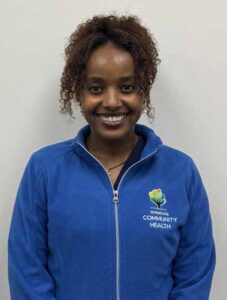 called out three physicians who were particularly encouraging while she studied toward her LPN, Oris Moore, DDS, Wilson Sithold, DDS and the late Henry Chionuma, an adult medicine internist who started SCH’s Walk-In Care operation.
“They all recognized my potential even when I did not,” she said. “Their guidance inspired me to strive for improvement, pursue opportunities for growth and seek further education. This journey has empowered me to take on more significant roles within our organization, enabling me to make a substantial impact on our system of care and the community we serve.”
Stated Platt, “SCH was great with allowing me to have a flexible schedule while studying for my boards. SCH staff also gave me amazing encouragement to continue to work toward my goals when they noticed I was struggling; they offer a great support system.”
Millwood, at one time a Medical Assistant, said that SCH played a significant role in her decision to pursue her lifelong dream of 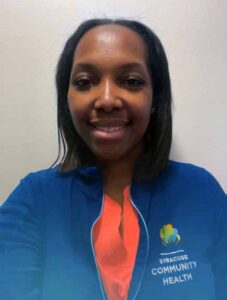 becoming an RN. “Working at SCH exposed me to a diverse patient population and allowed me to see the impact nurses have on improving patients’ lives,” she said.
“That experience inspired me to realize that I wanted to do more and take on a greater role in providing patient care. I would like to sincerely thank the entire Syracuse Community Health team for their encouragement and support throughout my nursing school journey. Their kindness, patience and belief in my potential motivated me to keep going, even during the most challenging times,” Millwood added.
“SCH loves to see their employees grow,” said Henderson. “Management actually listens to your concerns and tries to meet you where you are to help you along your career path. If you’re willing to work hard and give your best effort and take constructive criticism, SCH is the place to be.”
Nursing school is rigorous and demanding. Add work responsibilities and family obligations to the mix, and nurses often think twice about continuing their education. The support SCH gives its nurses can’t ease the challenges of school itself, but it can help mitigate the stress of the balancing act.
“Balancing family responsibilities with work and school proved quite challenging,” said He nderson Mitchell. “However, the assistance and support I received from SCH were unparallelled compared to any other organization where I have been employed.”
Odom agreed. “It got difficult at times juggling being a full-time parent, student and employee,” she said. “There were a lot of long nights being super tired but still having to show up and push through. I had a great support system and SCH was accommodating with any schedule adjustments that I needed.”
Millwood said that handling it all was as challenging as pursuing her nursing degree. “Working three days a week while attending classes required careful time management, organization and dedication,” she said. “I often had to balance long work shifts with studying, completing assignments and preparing for exams, which left little time for rest or personal activities.
“Although balancing these responsibilities was difficult, the experience strengthened my resilience, improved my time-management skills, and taught me the importance of perseverance. It also prepared me for the demands of the nursing profession, where managing multiple priorities while providing compassionate, high-quality patient care is essential.”
Legesse agreed. “Time management was the biggest challenge I experienced while balancing work, school and personal responsibilities,” she said about her LPN journey. “I worked part-time, my family kept me motivated and SCH helped by giving me a flexible schedule.”
Further, she was prepared for the rigors of advancing her career. “I knew this would be challenging but completely worth it,” she said.
A single mother, Henderson faced financial challenges in her quest. “Trying to manage personal finances, paying for school, and juggling home life was tough. But SCH supported me with schedule changes, especially Erin Healy, Dr. C and Heather Scott-Levy, director of nursing. They supported me from day one. I am forever grateful for each person that played a significant role in my journey.”
Grow Our Own
SCH administers a program called ‘Grow Our Own,’
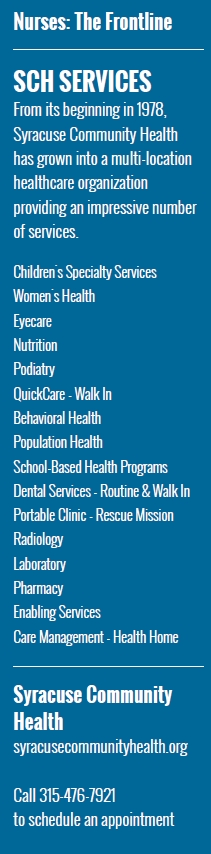
designed to attract individuals who possess a desire to pursue a career in the healthcare field with an intent to serve in community health centers. The program aims to foster personal and professional development, thereby retaining top-notch staff and ensuring quality patient care.
“We’re dedicated to ‘Grow Our Own’ to address the future shortage of primary care providers and supportive personnel,” Yoxall said. “By helping our employees grow through personal and professional development we can fill critical positions with internal candidates or secure critical competencies for our team.
“We achieve this through educational opportunities, clinical rotations, internships, cross training, career ladders and flexible schedules that align with school demands.”
In 2025, seven employees participated in ‘Grow Our Own,’ including medical assistants who became LPNs, as well as LPNs advancing to RN roles while working at SCH.
For those LPNs who are content in their current roles, this year SCH implemented a competency-based program. “This model helps identify opportunities for additional education and professional growth, provides quarterly feedback for all LPNs, and supports progression through three levels of increasing responsibility,” Yoxall explained. “This supports those who are not enrolled in formal coursework but want to continue to grow within their role.”
A quality facility that provides excellent patient care requires staff that is fully dedicated to the patient population, and nurses are a vital part of that team. “We are a reflection of our community, with a diverse workforce, some of whom are bilingual. We are constantly investing in our workforce,” Yoxall said, “which leads to better outcome for our patients, which then results in a healthier community.”